AI can analyze millions of data points in seconds.
It can summarize reports, identify trends, draft communications, and recommend next steps with astonishing speed. It’s certainly impressive.
But AI cannot walk into a meeting and feel the tension before anyone has spoken.
It cannot sense that a normally engaged employee has gone quiet.
It cannot recognize that today's disagreement has been building for months, or remember the conversation that happened in the hallway after last week's meeting.
And it certainly can't decide which organizational values should take precedence when there isn't a perfect answer.
That's the role of human wisdom, discernment, and judgment.
As AI becomes part of everyday leadership, we hear many people asking, What else can AI do?
But I think there’s an even more important question: What should leaders never stop doing?
Because while AI is becoming increasingly intelligent, judgment remains profoundly human.
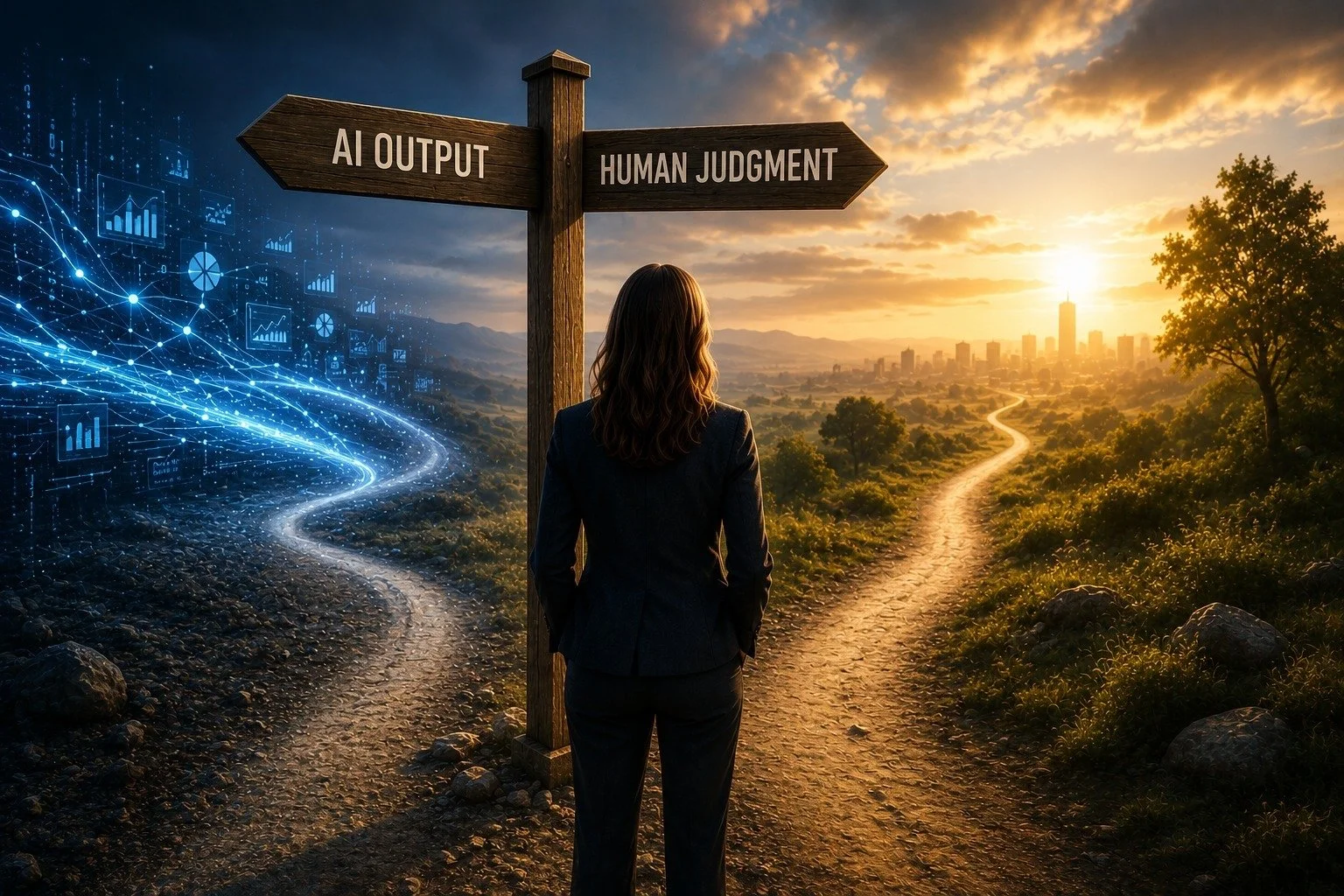
Same Answer. Different Outcome.
Imagine two leaders sitting in separate offices.
Both ask AI the exact same question.
"How should I handle an employee whose performance has declined?"
Both receive nearly identical recommendations.
One leader immediately follows the advice.
The conversation is professional, efficient, and well-worded. Performance concerns are clearly laid out and documented.
But what AI didn’t know was that the employee had been caring for an aging parent while quietly taking on additional work after a colleague resigned. It didn’t know that this was the first performance issue in twelve years, or that a little curiosity would have uncovered a completely different story.
So, while this conversation is delivered as a textbook performance conversation, it ends up damaging trust.
The second leader reads the same recommendation, then pauses.
Using good judgment, they ask: “What context is AI missing?”
They remember recent conversations. They consider the person's history, relationships, workload, and character. They decide not to rush the conversation. Instead, they first work to stabilize the employee's workload. When they eventually sit down together, they begin with questions instead of conclusions.
Same AI. Same recommendation.
Different leader. Different outcome.
The difference wasn't the technology. It was human judgment.
What Judgment Really Is
We often treat judgment like an instinct. It's much more than that.
Judgment is our ability to weigh competing priorities when there isn't a perfect answer. It's recognizing unintended consequences before they happen. It's balancing short-term efficiency with long-term trust. It's understanding that policies matter—but so do people.
And it's deciding when compassion should outweigh consistency, when coaching should come before correction, or when waiting one more day will lead to a better decision.
None of those answers exist in a dataset.
They emerge from experience, relationships, values, and wisdom.
Judgment is Becoming More Valuable
Ironically, AI is making judgment even more valuable. Why?
Because AI makes it incredibly easy to sound certain. Recommendations arrive polished, confident, convincing.
But confidence isn't wisdom. A beautifully written answer can still be the wrong answer for your organization.
That's why leaders can't confuse good output with good judgment.
AI should absolutely help us think better. It should challenge assumptions, generate ideas, and help us see possibilities we might have missed.
But it should never become the final decision-maker. Only people can assume responsibility for the consequences of a decision. Judgment should not be outsourced.
Before You Say Yes to AI...
Before acting on AI's recommendation, pause long enough to ask questions like:
What context doesn't AI have?
Who might be affected in ways this recommendation doesn't consider?
Does this align with the culture we're trying to build?
What unintended consequences could follow?
If this decision were made entirely by a human leader I deeply respect, would I still feel good about it?
Those questions may become some of the most important questions leaders ask in the AI era.
AI will continue to become faster, smarter, and more capable. That's something to embrace, not fear.
But as information becomes more abundant, judgment may become more scarce.
Guard yours carefully.
